At Foro Italico, Moroso Turns Tennis Hospitality into a Design Narrative
At the Internazionali BNL d’Italia, Moroso extends its role beyond furniture to become part of Alfabeti, an exhibition project where contemporary art, design and architecture reshape the experience of the tournament.

At major sporting events, hospitality is often treated as background — a layer of comfort around the main spectacle. At the Internazionali BNL d’Italia, however, that background has been reimagined as part of the cultural experience itself.

This year, Moroso renews its role as Official Supplier of the tournament while also participating in Alfabeti, an exhibition project curated by Giorgio Galotti and Claudia Pignatale for the spaces of Foro Italico, in collaboration with Sport e Salute and the Italian Tennis and Padel Federation. The result is not simply a furnishing intervention, but a broader spatial narrative in which art, design and architecture accompany visitors throughout the tournament.

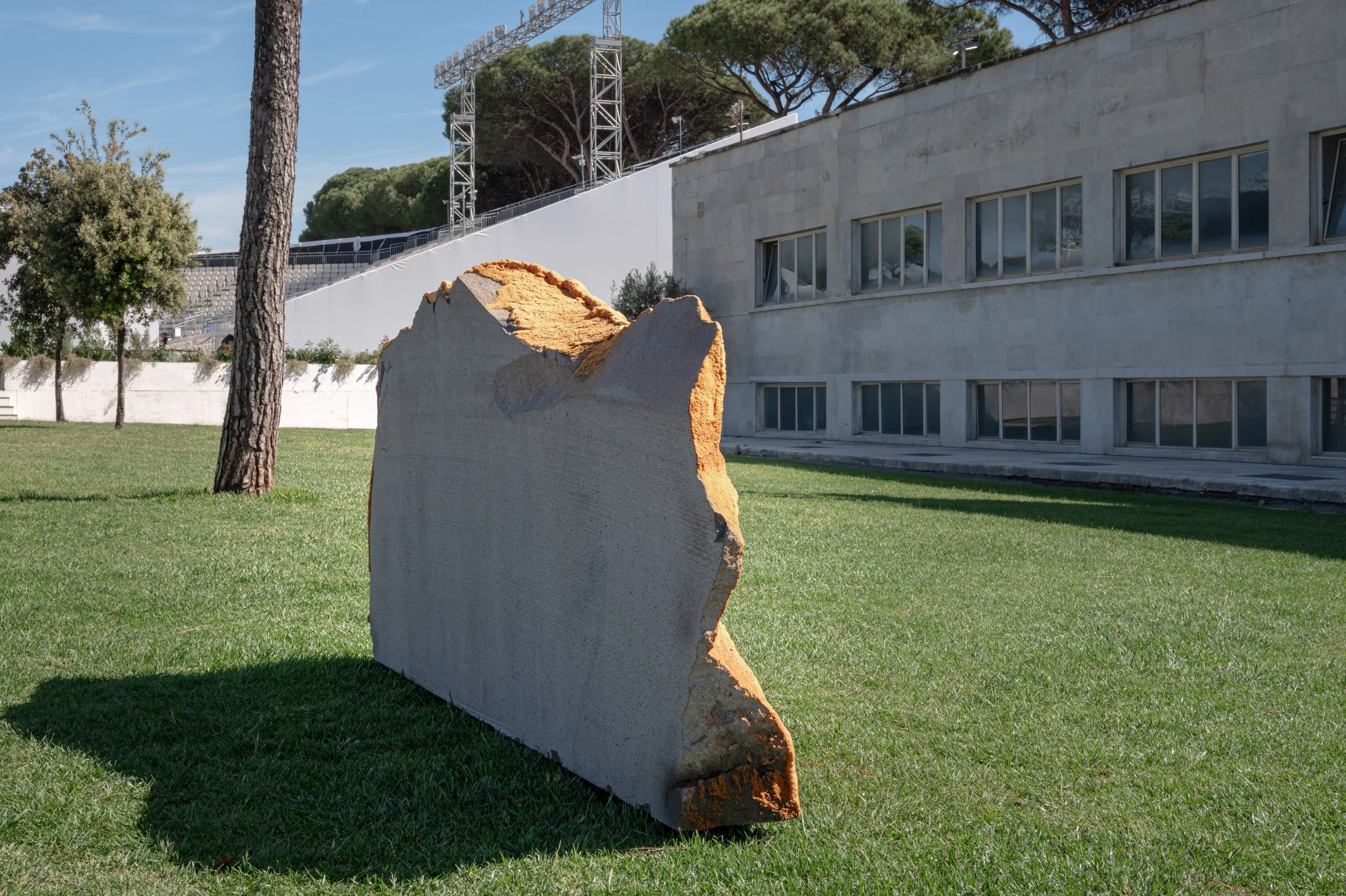
Conceived as a sequence of environments structured around language, memory and observation, Alfabeti unfolds from the Sala delle Armi to the Corporate Hospitality areas of the Central Stadium. Sculptures, installations and textual traces activate both interior and exterior settings, turning the event into something more layered than a sports venue and more fluid than a conventional exhibition. Here, visitors move through an itinerary of images, forms and atmospheres that quietly shift the tempo of the tournament.

Moroso’s contribution is especially effective because it does not impose itself as display. Instead, its furniture becomes part of the exhibition language — shaping places of pause, conversation and looking. In the Sala delle Armi, an environmental installation by Pietro Ruffo enters into dialogue with the architecture of Luigi Moretti and with Pebble Rubble, the sofa collection designed by Front for Moroso. With its organic forms inspired by stones and natural landscapes, the collection transforms the idea of rock into an experience of comfort and hospitality, softening the monumental character of the hall without diminishing its presence.

Further along the route, the hospitality lounges continue that dialogue between domesticity and public space. In the Foro Italico Club, Gruuve by Patricia Urquiola introduces a more fluid and informal rhythm, reinterpreting the free spirit of 1970s seating in a contemporary way. Nearby, One Page by Ron Arad compresses seat, armrests and backrest into a single sculptural gesture — turning furniture into something that sits between object and architecture.

In the Montemario Sud room, Josephine by Gordon Guillaumier takes centre stage. Its soft, sinuous profile deliberately moves away from the rigid geometry of the modern sofa, favouring instead a language of lightness and emancipation. The piece carries an almost character-like quality, further reinforced by its reference to Joséphine Baker — a name that introduces freedom, irony and performative elegance into the room. It is accompanied by Mathilda Lounge and Ruff, both by Patricia Urquiola, which extend the atmosphere of softness and sculptural tactility.

In Montemario Nord, Urquiola’s Pacific proposes another version of relaxation: broad, curved, edgeless, and almost landscape-like in its generosity. Here the lounge becomes a soft topography, enriched by textured fabrics and couture-like detailing. The room is completed by Mathilda Lounge, Ruff, and Square by Jonathan Olivares, creating an ensemble that feels less like contract furnishing and more like an inhabitable composition.

That is what makes this project especially interesting for THECORE. Moroso is not simply furnishing a prestigious tournament. It is helping turn the Internazionali BNL d’Italia into an aesthetic and cultural experience — one in which design contributes to the meaning of an event, not just its comfort. Through Alfabeti, hospitality becomes curatorial, furniture becomes spatial narrative, and the architecture of Foro Italico is read once again as a living frame for contemporary culture.

In a moment when the most interesting design often happens at the edges of disciplines, this feels particularly relevant. Sport, art and design are no longer separate worlds; at Foro Italico, they are part of the same conversation.